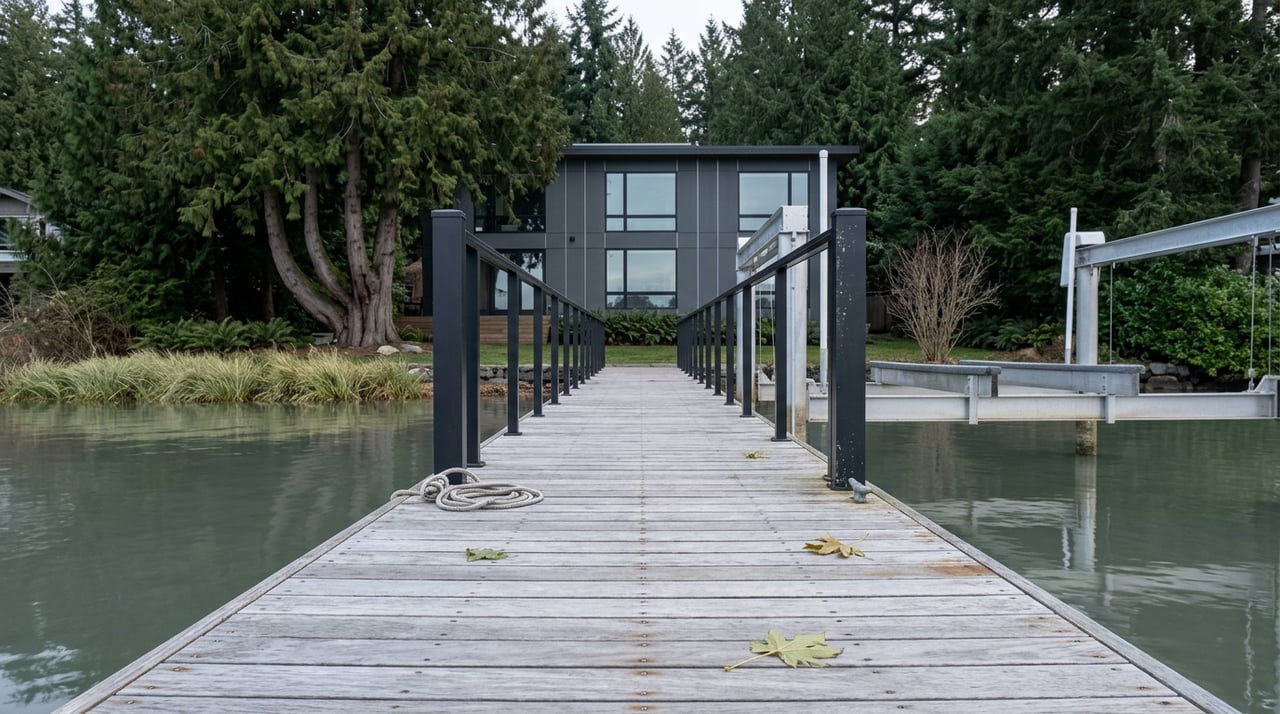
Before You Write an Offer on a Kirkland Waterfront Home, Ask About the Dock
September 3, 2026
September 3, 2026
Most Kirkland waterfront buyers ask about the roof, the furnace, and whether the seawall has ever been patched. Almost none ask whether the dock predates the current shoreline code, and whether the seller can produce paperwork proving it. That single question determines more about a future renovation budget than square footage ever will.
Here is the part that catches buyers off guard: a dock's legal status does not transfer the way a working appliance does. It transfers as untested. The structure can sit in front of a house for decades looking completely normal, and the moment anyone tries to repair it, three separate regulators start measuring it against rules written long after it was built.
Every dock on Lake Washington sits inside a jurisdiction that starts at a fixed point. Kirkland's zoning code sets the lake's ordinary high water mark against the NAVD 88 vertical datum at an elevation of 18.5 feet, and shoreline jurisdiction extends 200 feet landward from that line. That boundary was set by the city's Shoreline Master Program, not by whoever built the dock forty or sixty years ago.
The current code also limits what a new or rebuilt pier can look like. Most private docks are capped at 150 feet, or at the length set by the lakeward extent of neighboring docks, whichever is shorter, and a perpendicular platform off the walkway, known as an ell, is limited to 6 feet wide and 26 feet long. The city's own review files confirm another piece of this: only one pier or dock is permitted per property, full stop.
None of this is a problem for a dock that just sits there. Structures built before these standards existed are grandfathered in as legally nonconforming, and they are allowed to stay exactly as they are. What they are not automatically allowed to do is get bigger, or get rebuilt to the same footprint without review, the moment an owner triggers the wrong kind of construction activity. A dock that already runs the full 150 feet is one repair away from needing a shoreline variance, because there is no room left under the current rule to rebuild it as-is.
A straightforward, like-for-like fix on a Kirkland dock still runs through more than one office. Here is what that stack actually looks like.
| Agency | What They Review | Typical Timeline |
|---|---|---|
| City of Kirkland | Shoreline permit or exemption under the local Shoreline Master Program | Starting point for any dock work, city processed |
| Washington Department of Fish and Wildlife | Hydraulic Project Approval, required before repair or maintenance work begins on any in-water structure | About 45 days for standard review |
| Washington State Department of Ecology | Sets the dollar threshold that decides whether a project needs a full Substantial Development Permit or qualifies for an exemption | Threshold currently $28,000 in fair market value for a freshwater dock rebuilt at equal or smaller size, in effect since August 2023 |
That $28,000 number matters because it is the fork in the road. Go over it, or increase the footprint at all, and the project moves into a slower, fuller review track regardless of how routine the work looks on paper. For general shoreline development elsewhere in King County, the baseline threshold sits lower, at $8,504, which is why dock-specific projects get their own carve-out.
This is not a hypothetical. The City of Kirkland's own public permit file shows a dock maintenance repair processed this year at Homeport Marina, 135 Lake Street South. The application, filed under city permit number SHR26-00280, lists PMF Real Estate Services as the applicant and NW Dock & Pile as the contractor handling the work, which involved repairing damaged float sections and sinking a new concrete float into place. It was processed as an exemption from the full Substantial Development Permit requirement, dated in mid-April 2026. Routine work, but it still ran through the same layered shoreline review that every Kirkland waterfront owner eventually encounters.
Buyers hear "grandfathered" and assume it means permanent safety from every rule that came after. It means something narrower. An existing nonconforming dock can stay in place indefinitely. It cannot expand, and depending on its current dimensions, it may not be reconstructable to the same footprint without triggering review, because the current code has no headroom left to grant.
This is exactly where a buyer's assumption breaks down mid-transaction. Someone assumes the dock is there and working, so it must be fine. Then a survey or an insurance inspection turns up storm damage, the seller or new owner asks a marine contractor for a quote, and the contractor explains that fixing the dock as it currently sits would require a shoreline variance, because the existing structure already runs to the code's maximum length. What looked like a weekend repair becomes a permitting process measured in months, not days.
Waterfront lots in Kirkland concentrate in a handful of areas, including West of Market, Houghton, and Juanita, where lake access is part of what the price is buying. Buyers evaluating homes in these pockets are the ones most likely to run into this exact situation, simply because that is where most of the city's private docks and piers sit.
A seller who can produce a dock's permit history hands a buyer real information about future renovation costs. Here is what to ask for before submitting an offer, not after:
Can a legally nonconforming dock just stay as it is forever? Yes, as long as nothing changes. The moment an owner alters the footprint or size, or repair costs cross the threshold that triggers full review, the structure has to meet current standards for whatever portion is being rebuilt.
Does a small repair really need this much paperwork? Often, yes. The Homeport Marina float repair filed this April is a good example. It was routine maintenance, and it still required a formal exemption filing with the city, plus the underlying framework that would have required Hydraulic Project Approval had the scope been larger.
Where can a buyer actually see a property's permit history? The City of Kirkland's permit records are searchable by address through the city's own portal, and a seller can typically provide copies directly as part of a disclosure conversation.
None of this should scare anyone away from waterfront property in Kirkland. It should change what gets asked before an offer goes in. A dock's condition is only half the picture. Its paper trail is the other half, and it is the half that determines whether a future repair takes a month or a season.
If you are looking at waterfront listings in Houghton, West of Market, Juanita, or anywhere else along Kirkland's shoreline, The Koi Group can walk through a property's permit history with you before you write an offer, not after you are already under contract. Get your instant home valuation and let's talk through what a specific dock's history actually means for your plans.
Stay up to date on the latest real estate trends.